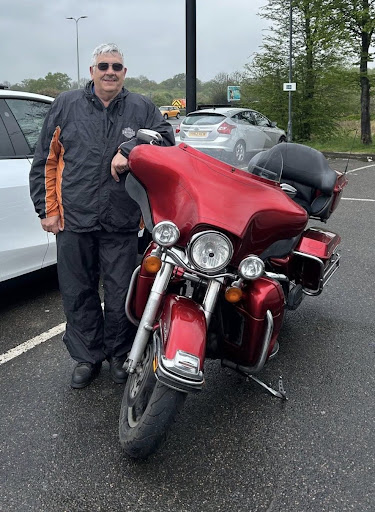
Michael is climbing the O2 this year on his tenth anniversary of losing his leg in a road traffic accident. In this blog post, he highlights the lessons he’s learned over the past ten years and how he’s set himself goals to propel himself forward. Michael is very much looking forward to championing lives beyond limb loss at this year’s O2 Climb, sponsored by Hodge, Jones & Allen.
More Than What’s Missing – Living, adapting and finding my own way as an amputee
Ten years ago, life changed in an instant when a suspected drink-driver collided with the motorcycle I was riding while travelling with a group of friends in the USA. I lost my lower left leg and, after being flown back to the UK, began a journey I had never expected to face. Being an amputee is now part of my story, but it is not the whole story.
Finding Support
In those early days, I often felt overwhelmed by the questions, the uncertainty and the many changes that came with limb loss. Then I found the Limbless Association, and everything began to feel more manageable. Their support helped me understand my limb loss in a way I could not have done alone, and their network of support for amputees has been outstanding.
That support did not remove every challenge, but it gave me knowledge, reassurance and a sense that I was not facing the future by myself. Over time, I have learned that adaptation is not a single breakthrough. It is a collection of small decisions, repeated until they begin to feel like a life again.
The Things People Don’t Always See
People often notice the visible difference first. What they may not see is the preparation behind a simple trip out: checking comfort, thinking about access, allowing extra time and deciding how much energy I have to spend. Some days everything works smoothly. On others, a minor irritation or an inaccessible space can rearrange the whole plan.
That unpredictability can be tiring. I have had to learn the difference between giving up and listening to my body. Rest is not failure, asking for help is not weakness and choosing a different route does not make the destination less worthwhile.
Identity Beyond the Label
There are moments when the word “amputee” feels useful. It connects me with a community, explains certain needs and gives language to an experience that can otherwise feel isolating. But no label can hold an entire person. I still have interests, responsibilities, bad jokes, ambitions and ordinary worries that have nothing to do with limb loss.
Questions, Curiosity and Kindness
Curiosity is natural, but timing and respect matter. Sometimes I am happy to answer a thoughtful question; sometimes I simply want to buy my shopping or enjoy a conversation without becoming an impromptu lesson. The kindest approach is to treat me as a person first, ask before offering help and accept the answer without making it awkward.
What I’m Learning
- Progress is rarely a straight line. A difficult day does not erase the work that came before it.
- Accessibility creates independence. Good design is not a special favour; it allows more people to participate fully.
- Community matters. Honest conversations with people who understand can make a lonely experience feel shared.
- My pace is still progress. I do not need to measure my life against someone else’s timeline.
Moving Forward
Moving forward has always meant setting myself goals. The biggest was getting back on my motorcycle, and eight months after the accident I achieved it. An earlier milestone came in October 2016, during my first family trip after losing my leg, when we visited Battle Abbey for a Battle of Hastings re-enactment. Castles have towers, and I have always climbed them whenever I could, so—with a walking stick in hand—I made my way up the steps to the top. If there is a challenge, whether it is walking up a steep hill or following a mountain path, I will give it a go. Over the years, I have climbed many more steps and tackled many slopes. They have not all been easy, but I keep trying.
This will not be my first time climbing the O2, but returning to do it on the tenth anniversary feels fitting: a chance to reflect on how far I have come and, quite literally, stand on top of the world. I look at the world differently now. Life as an amputee is not easy, and I choose my goals not because they are easy, but because I want to test myself and prove that I can still do many of the things I once did without a second thought.
If sharing this helps another amputee feel less alone—or helps someone understand that accessibility, patience and respect matter—then it is worth telling.
You can sponsor Michael here.