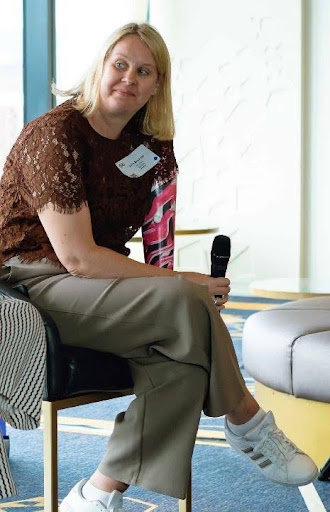
My name is Julia; I’m a mum to a busy blended family of four children aged 4 to 23 years old – life outside of work is rarely quiet! Work-wise, I’ve spent the last 20 years in the life sciences sector, leading teams developing molecular diagnostic tests that help improve patient care around the world. I am also an amputee.
I became an upper-limb amputee in my twenties. At the time, I could not have imagined where life would take me. Like many people facing a significant life change, I experienced uncertainty, frustration and grief. There were practical adjustments to make, but also changes to my confidence and sense of identity.
Before becoming an amputee, I was fiercely independent. I was used to solving my own problems, getting on with things and rarely asking for help. I was also a single mum to a very bubbly little girl. Suddenly, simple tasks such as making packed lunches or tying my daughter’s hair became puzzles to solve. Yet one of the biggest challenges after my amputation was not adapting to doing things differently. It was learning to accept help from others.
Asking for help felt uncomfortable. Accepting help that was freely offered felt even harder. At first, I was embarrassed that I could no longer do things that had once been easy. Over time, though, I realised that independence is not about doing everything yourself. It is about recognising when support will help you move forward. Learning that lesson made me stronger, both personally and professionally.
Another lesson came from managing phantom limb pain. Early on, someone shared a piece of advice that has stayed with me: “Don’t feed the lion.” The idea was simple: the more attention, frustration and energy I gave the pain—and the less I did as a result—the louder it seemed to become. That did not mean ignoring it or pretending it was not real. Phantom pain is very real, and anyone who experiences it knows how overwhelming it can be. But I learned that focusing on it constantly allowed it to dominate my thoughts and my day. Knowing when to acknowledge the pain, when to direct my attention elsewhere and when to do what I wanted regardless became an important part of managing it.
I have learned that resilience is rarely something you discover overnight. It is built gradually through the small decisions we make every day: choosing to keep going after a setback, to try something new and not to let fear make our decisions for us. That is why I am looking forward to climbing the O2 in October with the Limbless Association, sponsored by Hodge Jones & Allen. I hate heights, but I want to show myself that I can keep going without letting the fear of falling stand in my way. And if I need help, I’ll ask.
If you want to join me on my O2 journey, you can sponsor me here and help champion lives beyond limb loss.